Long-term outdoor waterproofing and corrosion protection Coating systems backed by evidence
Gaodun’s polyaspartic polyurea coatings use two reactive components. The company develops, synthesizes and manufactures aliphatic hardeners and polyaspartic ester resins in-house. Test data and outdoor application records show how the coatings perform and under what conditions.
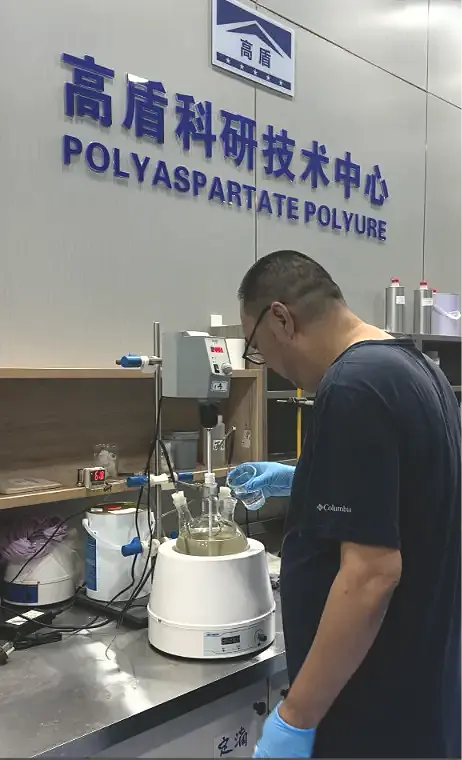
Technical review: Gaodun Research and Technology Center
AAliphatic Isocyanate PrepolymerBPolyaspartic Ester Resin✓Two-component reaction and film formation on site
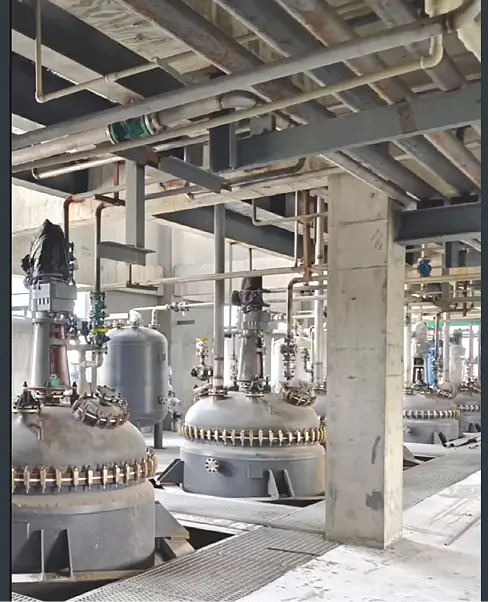
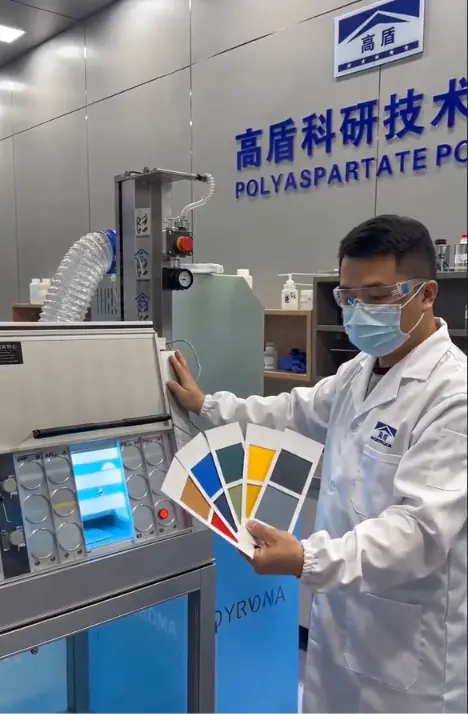
Formulation development and sample preparationPart A production systemGaodun laboratory accelerated weathering test
DIRECT ANSWER
How does polyaspartic polyurea form a coating?
Gaodun develops two-component material and application systems based on aliphatic isocyanate prepolymer Part A and polyaspartic ester resin Part B. On mixing, isocyanate and secondary amine groups undergo addition, forming substituted urea structures and a continuous crosslinked coating. Component synthesis, finished formulations, third-party tests, continuing laboratory verification and project feedback establish performance and application limits.
A + B MATERIAL SYSTEM
Two core components jointly define the film-forming system
A single raw material does not establish final performance. Validate A/B structures, stoichiometric ratio, compatibility, reaction rate and application conditions as a complete system.
A COMPONENTPart A
Aliphatic Isocyanate Prepolymer
Supplies isocyanate groups that react with the secondary amines in Part B to form crosslinks. Prepolymer structure influences flexibility, hardness, reaction rate and application direction. The prepolymer shown is a finished-coating example. The A suffix in raw-material grades N200A and N500A does not establish compatibility with a similarly named coating. Verify the specific combination against its grade documents.
During resin manufacture, an aliphatic diamine adds to a maleate diester to produce a polyaspartic ester resin with secondary amine groups. During field application, those groups in Part B react with isocyanate groups in Part A to form substituted urea linkages.
During application, secondary amines in Part B react with isocyanates in Part A to form substituted urea structures (R–NH–C(=O)–N(R¹)R²) and a continuous crosslinked polyaspartic coating. Raw materials, stoichiometry, mixing, thickness, substrate preparation, temperature and humidity all affect final properties. R, R¹ and R² denote attached organic groups. The formula shows a single reaction site.
A primary amine reacts with an isocyanate to form a urea linkage with one N–H bond on each side of the carbonyl group.
Polyaspartic Polyurea 聚天门冬氨酸酯聚脲(天冬聚脲)
Part A · Isocyanate group
+
Part B · Secondary amine in the aspartic resin · one N–H bond
→
Substituted urea linkage
The secondary amine in the aspartic resin reacts with an isocyanate. The amine nitrogen retains both organic substituents. Only the nitrogen from the isocyanate bears hydrogen in the resulting urea linkage.
New C–N bond The upper diagram shows a primary amine reacting with an isocyanate. In the lower diagram, isocyanate groups in the Part A aliphatic isocyanate prepolymer react with secondary amine groups in the Part B polyaspartic ester resin to form substituted urea linkages. Reaction at multiple sites in the multifunctional components forms a crosslinked film. The green single bond joins the isocyanate carbon to the amine nitrogen. Each diagram shows one reaction site. The aspartic resin is illustrated with an ethyl ester fragment. Et denotes ethyl, and R and R¹ denote the remaining organic groups. For the application mix ratio by mass, consult the technical data sheet (TDS) for the finished grade.
TECHNOLOGY PLATFORM
The complete technology chain from raw materials to projects
Gaodun connects development, production, testing and application feedback rather than treating one parameter as a complete technical conclusion.
01
Component synthesis
Independent synthesis and production of Part A aliphatic hardeners and Part B polyaspartic resins.
02
Formulation R&D
Adjust reaction, mechanical and application properties for waterproofing, corrosion protection, flooring and clear protection.
03
Performance testing
Choose tests for the grade and its intended use. When citing weathering or salt-spray results, identify the specimen, test method, conditions and outcome.
04
Application feedback
Continuously refine product and application limits using substrate, exposure, installation and follow-up records.
VERIFICATION SYSTEM
Data must identify its source and limits
Read each value in the grade’s technical data sheet (TDS) as labelled: a typical value or a specification. Third-party results apply to the submitted sample under the reported conditions. For measured values for a particular batch, consult its certificate of analysis (COA).
Third-party report TL26080331
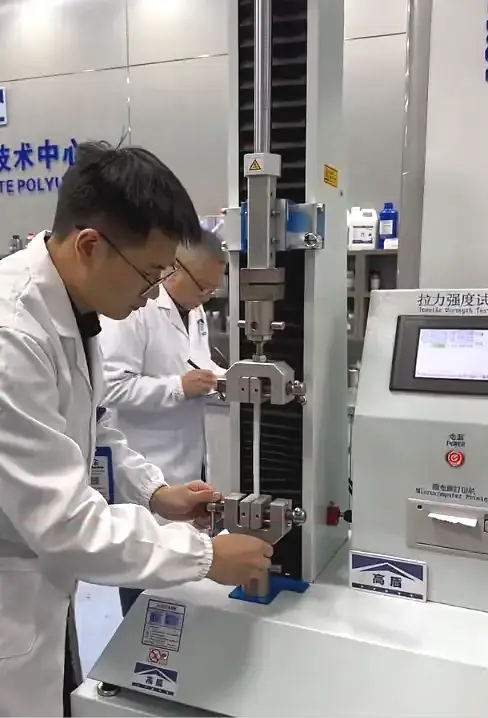
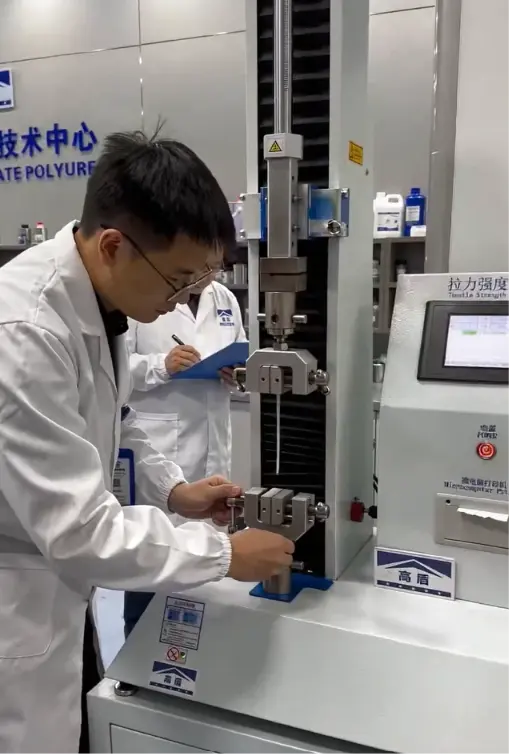
Mechanical and waterproofing properties
These are results for the submitted specimens under the conditions in third-party report TL26080331. The report records one submitted set and gives no grade-specific results.
Tensile strength · standard state
13.00 MPa Report TL26080331, submitted sample T26060219. No separate grade or batch results. PDF p. 4 · GB/T 16777-2008
Elongation at break · standard state
177% Report TL26080331, submitted sample T26060219. No separate grade or batch results. PDF p. 4 · GB/T 16777-2008
Water impermeability
0.4 MPa · 2 h · No water penetration (pass) Report TL26080331, submitted sample T26060219. No separate grade or batch results. PDF p. 4 · GB/T 16777-2008
Basis: GB/T 16777-2008 and the conditions listed in the report
Third-party report TL26080331
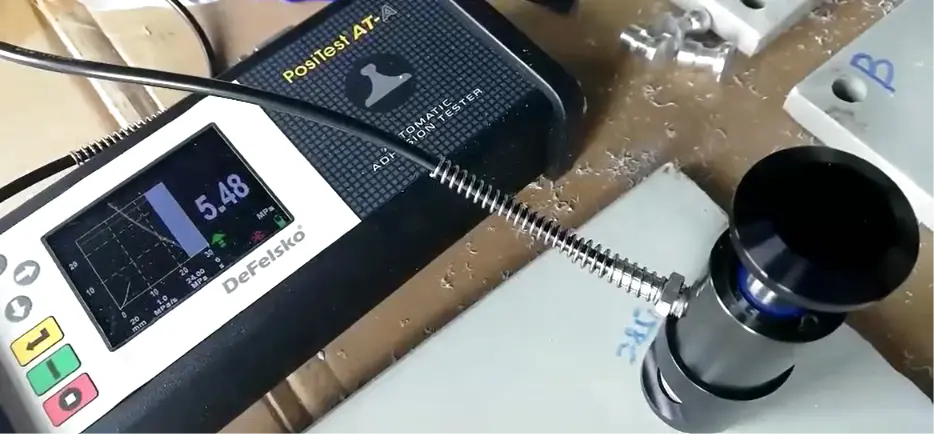
Adhesion data
These are results for the submitted specimens under the conditions in third-party report TL26080331. The report records one submitted set and gives no grade-specific results.
Concrete · pull-off adhesion
4 MPa Report TL26080331, submitted sample T26060219. No separate grade or batch results. PDF p. 5 · GB/T 5210-2006
Tile · pull-off adhesion
7 MPa Report TL26080331, submitted sample T26060219. No separate grade or batch results. PDF p. 5 · GB/T 5210-2006
Steel substrate · pull-off adhesion
5 MPa Report TL26080331, submitted sample T26060219. No separate grade or batch results. PDF p. 5 · GB/T 5210-2006
Basis: GB/T 5210-2006 and report conditions
Continuing Gaodun laboratory verification
Gaodun Lab Accelerated Weathering: 4,000 Hours
Gaodun reports 4,000 hours of in-house accelerated weathering. The cited material gives no associated sample ID, full method or endpoint assessment. This test is outside the scope of TL26080331.
One technology platform, different application targets
Grades use different technical approaches to hardness, flexibility, clarity, weathering, corrosion protection and decoration; they are not simply renamed products.
Secondary amines in Part B add to isocyanate groups in Part A, forming substituted urea structures and progressively building a continuous crosslinked polyaspartic coating.
Does the label “aliphatic polyurea” prove long-term outdoor suitability?
No. Check Part A structure, Part B resin, complete formulation, grade documents, weathering verification and actual application conditions.
Is A:B = 1:1 suitable for all polyaspartic products?
No. Mix each finished Gaodun coating by the mass ratio in its TDS. For formulation, confirm the resin’s active content, amine hydrogen equivalent weight and its basis, the hardener’s as-supplied NCO content, and the target NCO/NH equivalent ratio. Validate the formulation in trials. Amine value or pack weight alone cannot determine the mixing ratio. Check the pot life for the specific coating and site temperature against its TDS.
Does 4,000-hour artificial weathering establish 15 or 20 years of service?
Gaodun reports 4,000 hours of in-house accelerated weathering. The cited material gives no sample ID, complete method or endpoint assessment. Third-party report TL26080331 does not cover this test. The material provides no 15- or 20-year service-life or warranty commitment. Assess exposure, substrate, film thickness, application and maintenance for the specific project.
Should I buy N200 or N200A for a clear topcoat?
Choose the N200 finished clear topcoat and check compatibility with the underlying layer. N200A is a hardener for formulation development. The suffix does not establish a compatible pairing.
Can I use the reported tile adhesion of 7 MPa to accept my existing tiles?
No. Report TL26080331 gives 7 MPa for submitted specimen T26060219 under GB/T 5210-2006. Repair hollow or loose tiles, then clean, dry and abrade the surface. Test adhesion on a prepared patch of the actual tiles and apply the agreed project acceptance criteria.
TECHNICAL CONSULTATION
Assess technical options from project conditions
Provide city, application, substrate, area, exposure and intended service requirements.
 Third-party report TL26080331
 Third-party report TL26080331