LOW-REACTIVITY POLYASPARTIC RESIN
Low reactivity · Longer application windowGD-1520
Polyaspartic Ester Resin
For high-solids, two-component formulations that need a longer pot life and time to level, including large-area floors and appearance-sensitive anticorrosive finishes. Use GD-1520 as the sole resin or blend it with GD-1422, then crosslink with a compatible aliphatic polyisocyanate hardener.
Application positioning comparable to NH 1520Verify pot life by formulation trial200 kg drum
GD-1520Low-reactivity resin
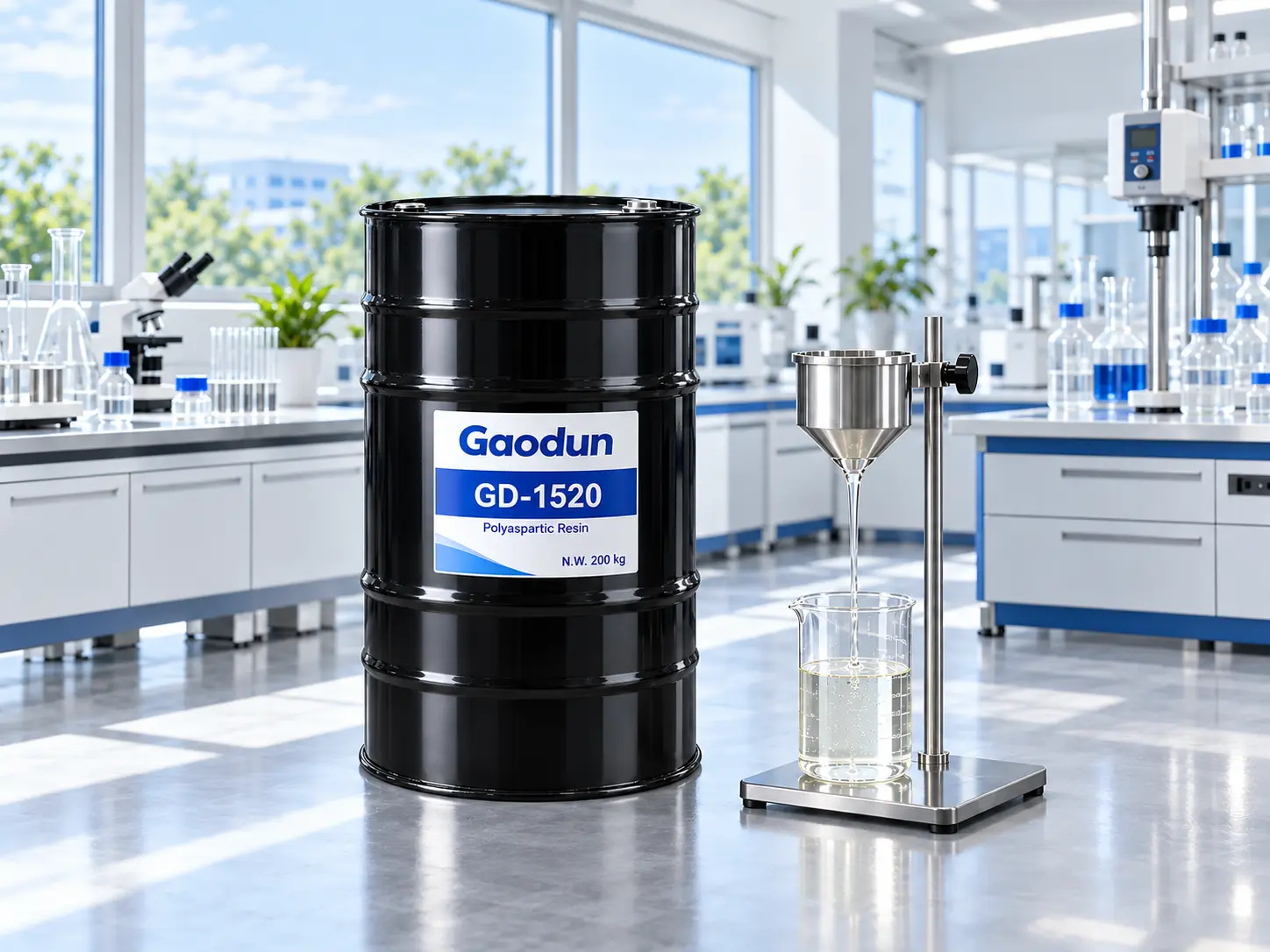
Product definition
GD-1520 is a low-viscosity, lower-reactivity amino-functional polyaspartic ester resin. Evaluate it when the mixed material needs a longer pot life and time to level. Compare or blend it with GD-1422 resin to adjust reaction and drying rates. Determine pot life, drying rate and recoat conditions separately in the target formulation. NH 1520 is a reference for comparable applications. Verify compatibility, processing and target performance before substitution.
TECHNICAL DATA
Raw-material specifications and reference data
Raw-material specifications cover solids, color and viscosity at 25 °C. Amine value is a manufacturer reference range. Density at 20 °C, flash point and the reported equivalent value are approximate. The source gives about 293 g/mol. Its definition and unit require technical confirmation before any hardener calculation. Use the agreed specification, batch COA and supply contract for batch acceptance.
- GD-1520 · Chemical type
- Lower-reactivity polyaspartic ester resin · material identity
- GD-1520 · Solids content
- 99% · material specification
- GD-1520 · Amine value
- 189–193 mg KOH/g · manufacturer reference range
- GD-1520 · Reported equivalent value (unconfirmed)
- ≈293 g/mol · definition and unit unconfirmed · unsuitable for dosing calculations
- GD-1520 · Viscosity at 25°C
- 900–2000 mPa·s · material specification
- GD-1520 · Density at 20°C
- Approximately 1.07 g/cm³ · approximate value
- GD-1520 · Color value
- APHA≤250 · material specification
- GD-1520 · Flash point
- Approximately 96°C · approximate value
- GD-1520 · Packaging
- 200 kg/drum · net resin weight
RECOMMENDED APPLICATIONS
Suggested application directions
Large-area industrial flooring
Allows more time for mixing, application and leveling.
Appearance-sensitive anticorrosive finishes
Industrial finishes requiring leveling and application continuity.
Resin blending to adjust reactivity
Blend with GD-1422 to balance working time and drying efficiency.
SYSTEM PAIRING
System compatibility and selection
N-200A and N-500A are candidate hardeners. GD-1422 is a resin blend partner. Before setting a mass ratio, confirm active resin content, amine hydrogen equivalent weight, as-supplied hardener NCO content or equivalent weight, and the target NCO/NH equivalent ratio. Test the actual substrate, primer, hardener and intended application method for adhesion, compatibility, cure and target performance. A 200 kg drum contains resin only. No fixed A/B mass ratio, kit weights, application temperature, coverage, film build, coat count, fixed pot life, recoat interval, coating service life or warranty period is specified.
| Suggested combinations | Target system |
|---|---|
| GD-1520 + N-200A | Candidate hardener. Validate in the intended formulation. Longer pot life, high-quality finishes and large areas |
| GD-1520 + N-500A | Candidate hardener. Validate in the intended formulation. Flexible waterproofing and flooring with a longer application window |
| GD-1520 + GD-1422 | Candidate resin blend. Verify in trials. Adjust reaction rate to the target working time |
SUPPLY & SUPPORT
Packaging, supply and technical support
Storage and shelf life:Store sealed at 0–40 °C and protect from moisture. The temperature applicable to shelf life and its start date require technical confirmation. Confirm shelf life against the label and documents for the supplied batch. Consult the current SDS for handling, transport and personal protection.
MODEL TECHNICAL DATA SHEET
GD-1520 dedicated technical data sheet
Lower-reactivity polyaspartic ester resin. Amine value 189–193 mg KOH/g, viscosity 900–2000 mPa·s at 25 °C and 200 kg net resin per drum.
Grade → Properties → Applications → Compatibility → Documents
Page 1: Positioning, packaging and key information
Page 2: Typical technical properties and data limitations
Page 3: Suggested applications and system compatibility
Page 4: Packaging, storage, safety and document traceability
V1.4 · 2026-11-19
Technical preparation/review responsibility: Shenzhen Gaodun New Materials Co., Ltd.
References comparable NH 1520 applications for preliminary selection, not a guarantee of identical product or performance. Batch COA and supply contract govern delivery.
Request GD-1520 TDS, samples and quotation
Provide country or region, company, estimated purchase quantity, intended application, current system and WhatsApp or email contact.
Frequently asked questions
When should GD-1520 be assessed?
Assess Gaodun GD-1520 lower-reactivity polyaspartic ester resin where longer pot life, leveling or large-area application is needed, with formulation trials using the selected hardener.
Explore Raw MaterialsIs GD-1520 a drop-in replacement for NH 1520?
It is a candidate for similar applications. Trial GD-1520 when a longer working window is needed. Check compatibility, pot life, leveling and film performance with the intended hardener under actual application conditions before switching.
Which hardener should I trial if flexibility matters, and when can I recoat?
Trial N-200A for a large-area finish where appearance is critical, or N-500A when flexibility takes priority. Check adhesion on the intended substrate with the selected hardener at the application temperature. Measure pot life, drying and recoat conditions separately.
Can I use the listed 293 g/mol to dose a drum of resin?
No. The 200 kg figure is net resin weight. The meaning and unit of the reported 293 g/mol require confirmation. Verify active content, amine hydrogen equivalent weight, batch hardener NCO content and the target NCO/NH equivalent ratio before formulation trials.
When does shelf life start for resin stored sealed at 0–40 °C?
Confirm expiry from the batch label and written supply documents. The 0–40 °C range applies to sealed, dry storage. Both the temperature applicable to shelf life and its start date require technical confirmation.