POLYASPARTIC TECHNICAL ARTICLES
Polyaspartic Polyurea Technical ArticlesWhat Is Polyaspartic Polyurea?
Polyaspartic polyurea is a coating system formed by the reaction of polyaspartic ester amine-containing resin and isocyanate component. Its weather resistance, curing speed and mechanical properties are determined by the specific raw materials structure, formula and construction conditions. This article explains the meaning of the material name from the three links of resin, curing agent and on-site mixing, and introduces the different properties that should be paid attention to when selecting materials for roof waterproofing, flooring and metal protection. When checking product information, you should distinguish between raw materials descriptions and finished product reports, and confirm the corresponding model, substrate surface conditions, coating structure and detection methods. Whether a certain process can actually be used needs to be judged based on the product's technical data and on-site verification.
Article contents (5 sections)
Definition and reaction film formation
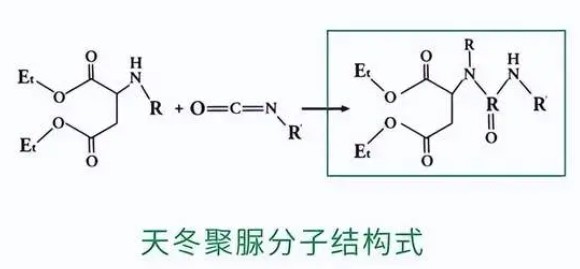
Secondary amine groups in the resin react with isocyanate groups to form urea linkages. Multifunctional reactants can form a crosslinked protective coating. Resin is raw materials, polyaspartic polyurea is the common name of the corresponding coating or film formation system, and the two should not be directly synonymous with each other.
Main technical features
- Adjustable formula: adjust pot life and curing speed through the combination of resin and isocyanate
- High solids system can be developed: whether it is solvent-free and the specific VOC value should be based on the product information.
- Can be used for outdoor protection: usually select an appropriate aliphatic weather-resistant system and verify it through corresponding tests
- Performance targets vary: hardness, flexibility, wear resistance and media resistance cannot be considered as guaranteed values for all models
Comparison with Epoxy and Fast-Cure Spray Polyurea
| Compare dimensions | polyaspartic polyurea | Epoxy coating | Quick-set spray polyurea |
|---|---|---|---|
| reaction system | Reaction of amine-containing resins with isocyanates | Epoxy resin reacts with compatible system curing agent | Amines react quickly with isocyanates |
| outdoor performance | Depends on raw materials, formula and testing | Different systems vary greatly and often require appropriate weather-resistant surface layers. | Relating to aromatic or aliphatic structures and systems |
| Construction and curing | Adjustable pot life, designed and constructed according to product | Determine according to curing agent, temperature and formula | Specialized two-component equipment is often used |
| Mechanical properties | Designed for hardness, flexibility or wear resistance | Determined according to formula and compatible system | Designed for waterproof, elastic or wear-resistant purposes |
| Temperature and return-to-service time | Subject to corresponding product TDS and site conditions. | Subject to corresponding product TDS and site conditions. | Subject to corresponding product TDS and site conditions. |
Applications and usage restrictions
Corresponding product systems can be evaluated for building waterproofing, decorative floors and industrial surface protection. The specific model must be selected based on substrate, film thickness, old coating status and environment; long-term water immersion, special chemical media and structural cracks need to be judged individually.
"Solvent-free" cannot be understood to mean that it can be applied in a confined space without protection, nor can it promise that all formulas will not yellowing, powdering or cracking for a long time. Construction safety should be based on SDS, and performance should be based on corresponding model testing and actual verification.
Further reading and technical information
The links below provide background on the topic. When it comes to specific performance, product selection or engineering parameters, please check the applicable objects and test conditions of each data.
- Covestro: Pasquick®polyaspartic ester system technology introduction Source (solutions.covestro.com)
- Covestro: high solids and solvent-free system Source (solutions.covestro.com)
- BASF: Isocyanate safe handling information Source (chemicals.basf.com)
The above are system principles and safe operation references, not testing or certification of a certain model by Gaodun. The specific performance, construction environment, ratio, pot life and protective measures are subject to the corresponding product TDS, SDS, test report and on-site verification.