POLYASPARTIC TECHNICAL ARTICLES
Polyaspartic Polyurea Technical ArticlesWhat Is Polyaspartic Ester Resin?
Polyaspartic ester resin is a reactive raw material containing secondary amine active hydrogen, which can react with isocyanate components to form urea linkages. Resin raw materials and reacted polyaspartic polyurea coating belong to different concepts. When purchasing, check whether the documentation covers a resin raw material or a matched two-component coating product. This article explains the basic relationship between resin and isocyanate reaction film formation, and introduces why pot life and film formation performance need to be evaluated in conjunction with the formula. When judging outdoor color stability, substrate adhesion or construction time, the technical information and test conditions of the corresponding finished product should be checked. The technical description of raw materials can help understand the reaction route, but cannot replace the verification of actual coating under specified substrate surface and working conditions.
Article contents (6 sections)
The difference between raw materials and finished coating
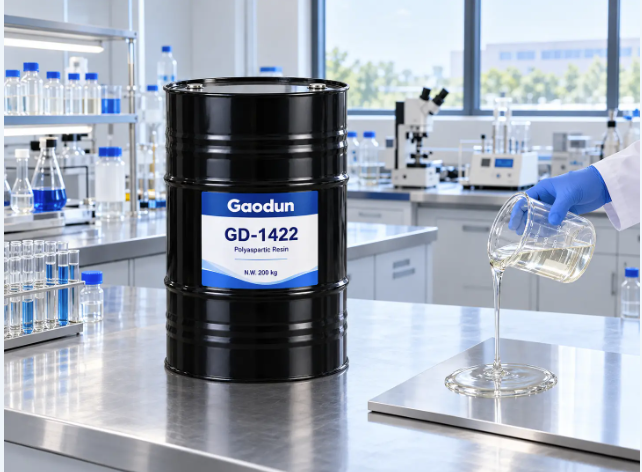
Polyaspartic ester resin (Polyaspartic Ester) is usually used as the amine-containing resin component in two-component coatings. After it is mixed with the isocyanate component, it undergoes a chemical reaction to form a crosslinked coating containing urea linkages. Gaodun uses Part A for isocyanate system and Part B for polyaspartic ester resin and formula system naming; other manufacturers may have different component numbers.
Why can the reaction speed be adjusted?
Compared with many primary amine systems, the secondary amine structure of polyaspartic ester resin and the groups around the molecule will affect its reactivity with isocyanate. Selecting different resins and curing agents, and adjusting the formula, can achieve a balance between pot life and curing speed; all curing behaviors cannot be explained by "steric hindrance" alone.
High solids content and safe application
Low viscosity resins facilitate the development of high solids or solvent-free formulations, but not all polyaspartic polyurea products are 100% solids or zero VOC. Whether to add solvent, VOC value and detection method should be confirmed according to the specific formula and data.
Solvent-free does not mean hazard-free. Isocyanates and other formula components may still pose health risks. Spraying and enclosed space construction require ventilation and personal protection measures in accordance with SDS and operating conditions.
The performance after film formation is determined by the complete system
- Outdoor color and appearance stability: It is related to the isocyanate structure, resin, pigments, fillers, additives, film thickness and environment. These factors must be evaluated before making claims about yellowing or chalking.
- Pot life is the time after mixing during which the product remains suitable for application under specified conditions. It depends on the formulation, mixed quantity and material temperature. For return to service, check the product’s cure requirements for the actual film thickness, curing conditions and intended load.
- Adhesion and corrosion protection performance: need to be judged based on substrate processing, compatible system primer, film thickness and detection conditions
Application conditions and boundaries
Building surfaces, industrial equipment, metal components, wood and floor protection can be evaluated according to specific product systems. Before applying the coating to existing tile, stone, metal or paint, test compatibility and adhesion on the substrate. Before coating over asphalt or an existing flexible waterproofing layer, verify that the proposed system is suitable for that substrate.
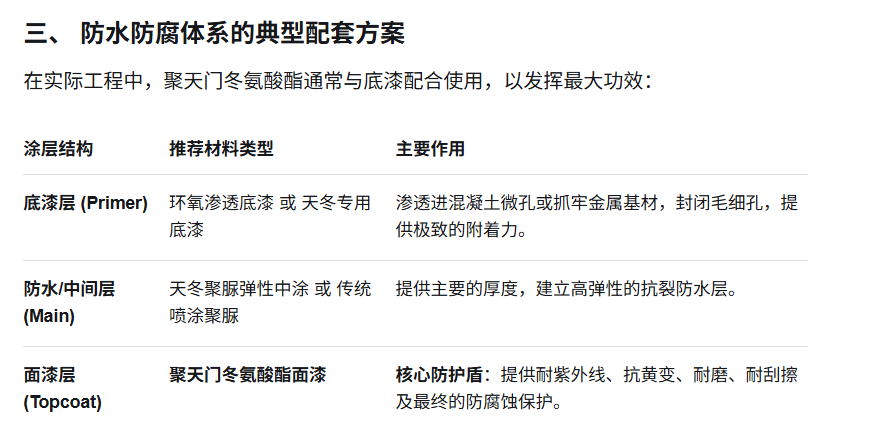
Working conditions such as long-term water immersion, ocean splash or tidal range, leading edges of wind turbine blades and special chemical media require special systems and special verifications; promises of 15-30 years of life, chlorine corrosion resistance or ultra-low temperature construction cannot be made based on the material name alone.
Further reading and technical information
The links below provide background on the topic. When it comes to specific performance, product selection or engineering parameters, please check the applicable objects and test conditions of each data.
- Covestro: Pasquick®polyaspartic ester system technology introduction Source (solutions.covestro.com)
- Covestro: high solids and solvent-free system Source (solutions.covestro.com)
- BASF: Isocyanate safe handling information Source (chemicals.basf.com)
The above are system principles and safe operation references, not testing or certification of a certain model by Gaodun. The specific performance, construction environment, ratio, pot life and protective measures are subject to the corresponding product TDS, SDS, test report and on-site verification.