POLYASPARTIC TECHNICAL ARTICLES
Polyaspartic Polyurea Technical ArticlesWhat Is the Difference between Polyurea and Polyaspartic Polyurea?
Polyaspartic polyurea belongs to a technical route of polyurea system. When comparing, you should look at the amine-containing resin structure, isocyanate type and formula conditions separately. All ordinary polyureas cannot be equated with aromatic quick-curing spray systems. When selecting materials, reaction speed, construction equipment, open-air use conditions and substrate treatment can be compared separately. This article distinguishes between two common construction routes, fast-setting spray polyurea and polyaspartic polyurea, and explains the influence of aromatic or aliphatic structure on the judgment of appearance weather resistance. Readers can check the specific models, compatible system practices and test data with the supplier to confirm whether the construction window and subsequent maintenance are suitable for the project. For different items such as roofs and floors, the information should also be checked separately based on actual usage conditions.
Article contents (6 sections)
First clarify the comparison objects
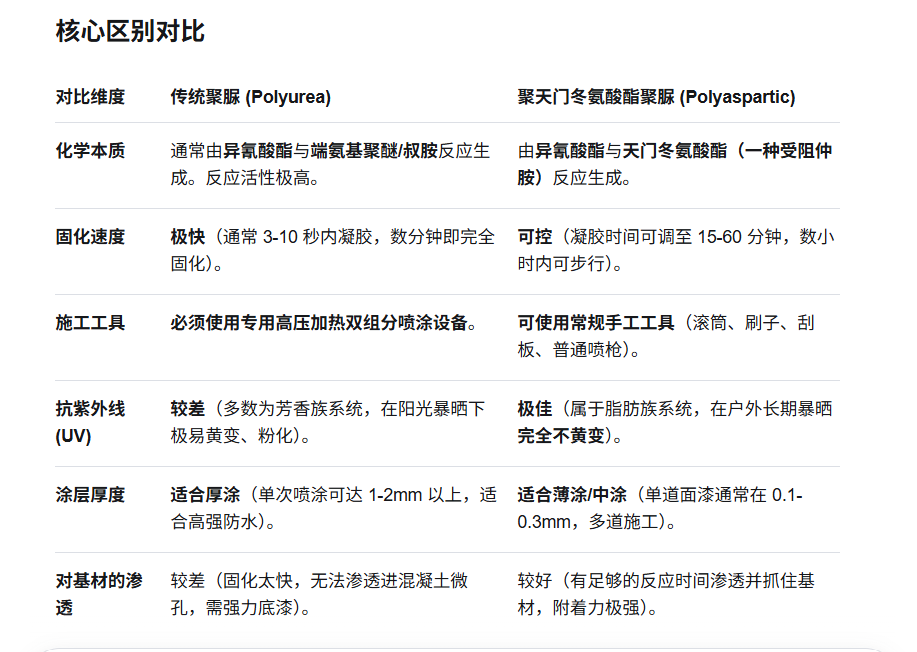
Polyurea is a broader class of materials. Polyaspartic polyurea uses polyaspartic ester resin containing secondary amine groups to react with isocyanate components for film formation. Fast-setting two-component spray polyurea is another common application route, but it does not represent all polyurea products. This article compares technical routes and does not regard marketing generations such as "third generation" as a unified industry standard.
Response speed and construction methods
Many fast-set spray polyureas are suitable for mixing and application with specialized two-component equipment. Polyaspartic ester systems usually have a pot life that is easier to adjust and can be developed for brushing, rolling, scraping or corresponding spraying formulations. The actual pot life depends on the resin, isocyanate, formula, temperature and humidity, and should not be written uniformly as 20-40 minutes.
Weather resistance can’t just look at the name of polyaspartic polyurea
Systems used for long-term outdoor use usually choose aliphatic or appropriate cycloaliphatic isocyanate structures. Aromatic isocyanate formulations are generally more susceptible to light yellowing, but aromatic polyaspartic polyurea and aliphatic spray polyurea may also be present. Therefore, the structure of Part A raw materials and the film formation test should be checked, and it should not be inferred that "all polyaspartic polyurea are not yellowing" or "all spray polyureas are easy to yellowing".
Technical route comparison
| Compare dimensions | Common routes for fast-setting spray polyurea | polyaspartic polyurea route |
|---|---|---|
| Resin Characteristics | More reactive amine systems are often used | Use polyaspartic ester containing secondary amine resin |
| Construction method | Specialized two-component spray equipment is often used | Can be brushed, rolled, scraped or sprayed according to formula design |
| reaction speed | Many systems respond quickly | Can be adjusted through resin and compatible system |
| Outdoor weather-resistant | Related to isocyanate structure and formula | It is also necessary to check the isocyanate structure and detection |
| Selection basis | Working conditions, film thickness, equipment and construction conditions | Working conditions, appearance, pot life and compatible system conditions |
How to judge suitability?
- Confirm the substrate, exposure conditions, whether it has been immersed in water for a long time, and the target film thickness
- Check resin and isocyanate structure, product TDS and SDS
- Compare the corresponding test conditions for adhesion, weather resistance, abrasion resistance or media resistance
- For special projects, site trial or special verification must be done first, and results cannot be promised based on a single material category.
Further reading and technical information
The links below provide background on the topic. When it comes to specific performance, product selection or engineering parameters, please check the applicable objects and test conditions of each data.
- Covestro: Pasquick®polyaspartic ester system technology introduction Source (solutions.covestro.com)
- Covestro: high solids and solvent-free system Source (solutions.covestro.com)
- BASF: Isocyanate safe handling information Source (chemicals.basf.com)
The above are system principles and safe operation references, not testing or certification of a certain model by Gaodun. The specific performance, construction environment, ratio, pot life and protective measures are subject to the corresponding product TDS, SDS, test report and on-site verification.